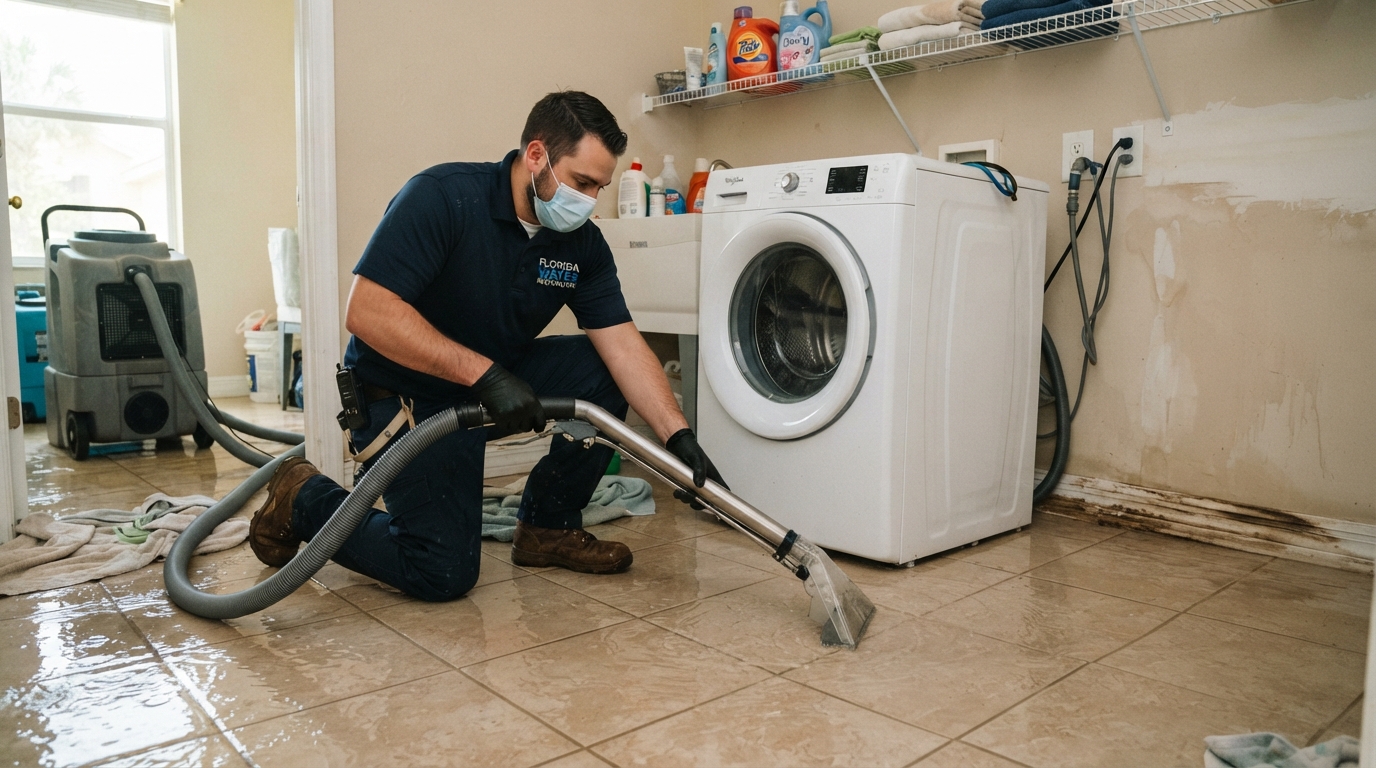
Water Extraction & Drying After Washing Machine Leaks and Overflows
Washing Machine Overflow & Laundry Room Water Damage Cleanup Daytona Beach
Water removal and structural drying after washing machine supply hose failures, drain overflows, and laundry room flooding. We address water that has spread beneath flooring and into adjacent rooms throughout Daytona Beach.
Request Water Damage Service
Fill out the form below and our team will get in touch with you immediately.
Common Washing Machine Water Losses in Daytona Beach
Washing machines are one of the most common sources of indoor water damage in Daytona Beach homes. A supply hose can burst while the machine is running, releasing water continuously until the supply is shut off. A drain hose can dislodge or back up, sending used water across the laundry room floor. An internal component failure can cause the machine to overflow during a wash cycle. Even a slow, unnoticed leak from a loose connection can saturate the flooring and drywall behind the machine over time.
Laundry rooms in Daytona Beach homes are often located near kitchens, hallways, or interior closets. Water from an overflow does not stay contained within the laundry room. It flows beneath walls, under doors, and into adjacent spaces. In multi-level homes, a laundry room on an upper floor can send water down through the ceiling of the room below.
Common Laundry Room Sources
- Supply hose bursts and failures
- Drain hose dislodgement or backup
- Machine overflow during wash cycle
- Appliance connection leaks
- Drain line backups and clogs
- Slow, unnoticed leaks behind the machine
Areas That Can Be Affected
- Laundry room flooring and subfloor
- Drywall and baseboards
- Adjacent closets and hallways
- Nearby kitchens and living areas
- Ceilings below (upper-floor laundry)
- Cabinets and nearby fixtures
Because water from a washing machine can spread well beyond the laundry room, a thorough assessment with moisture detection tools is necessary to identify the full extent of the water loss. If significant standing water is present, our emergency water removal service addresses bulk water extraction before drying begins.
Laundry Room Water Damage Cleanup Process
A systematic approach to water extraction, moisture detection, and structural drying after washing machine overflows and laundry room water losses.
Stop Water Flow or Appliance Operation
If it is safe to do so, shut off the water supply valves behind the washing machine or turn off the main water supply. Unplug the machine if it is safe to reach the outlet.
Address the Appliance or Plumbing Source
The failed supply hose, drain hose, or appliance component should be addressed by the appropriate professional. Water damage cleanup addresses the resulting water, not the repair of the washing machine itself.
Extract Standing Water
Standing water is extracted using professional equipment to remove bulk water from laundry room flooring and any adjacent areas before it migrates further into the structure.
Inspect Laundry Flooring
We evaluate the laundry room floor for saturation, checking tile, laminate, vinyl, or other flooring types for water that has penetrated beneath the surface.
Evaluate Surrounding Walls & Baseboards
Drywall, baseboards, and walls surrounding the laundry area are inspected for moisture absorption. Water can wick up drywall from wet flooring.
Check Adjoining Spaces
Water from a laundry room frequently travels into adjacent hallways, kitchens, closets, and nearby rooms. We map the full extent of the water loss using moisture detection tools.
Dry and Dehumidify Affected Materials
Air movers and dehumidifiers are positioned to promote evaporation and capture moisture released from wet building materials into the indoor air.
Monitor Moisture & Evaluate Remaining Damage
Moisture levels are checked during the drying period, and once drying goals are reached, we evaluate any remaining affected materials and discuss appropriate next steps.
Moving appliances should only be done when safe and after the water supply has been shut off. We can help coordinate access to flooring beneath the washer and dryer once the area is safe and water has been extracted.
Flooring & Hidden Moisture After a Washer Overflow
Different flooring types respond to water differently. Understanding how water interacts with each material helps determine the appropriate drying approach.
Tile Flooring
Water can enter through grout lines and perimeter assemblies, reaching the subfloor beneath the tile. While tile itself is water-resistant, the materials beneath it are not. Moisture meters help determine whether water has penetrated beneath the surface.
Laminate & Engineered Flooring
Laminate and engineered flooring are sensitive to moisture. Water can seep between planks and cause swelling or warping. Each situation is evaluated individually to determine whether the flooring can be dried or whether sections need replacement.
Hardwood Flooring
Hardwood can absorb water and may cup or warp depending on the volume and duration of exposure. Moisture meters help determine whether water has penetrated the wood and subfloor. In some cases, hardwood can be dried in place; in others, replacement may be necessary.
Carpet & Padding
Carpet in adjacent rooms can absorb water that has traveled from the laundry area. Professional extraction removes water from the carpet and padding. The padding beneath may need evaluation depending on the amount of water and the category of the loss.
Beyond the Flooring
Water from a washing machine overflow does not stop at the laundry room floor. It can travel beneath baseboards, up into drywall, behind cabinets, and into adjacent rooms. The subfloor beneath finished flooring can remain wet even when the surface appears dry.
Moisture detection tools are used to evaluate all of these areas. If water has migrated into wall cavities or beneath flooring, our structural drying and dehumidification service addresses the next stage of mitigation after bulk water has been extracted.
Washing Machine Overflow Cleanup FAQ
Answers to common questions about laundry room water damage, washing machine overflows, and cleanup in Daytona Beach.
If it is safe to do so, shut off the water supply valves behind the washing machine or turn off the main water supply. Unplug the machine if you can safely reach the outlet. Use towels to contain spreading water and protect adjacent rooms if possible. Avoid operating the machine until the issue has been addressed. Contact Daytona Beach Water Damage Restoration at 386-401-5178 so extraction can begin before water migrates beneath flooring and into adjacent rooms.
Yes. Water from a washing machine overflow can flow beneath tile, laminate, vinyl, and other flooring types through grout lines, seams, and edges. Once beneath the surface, water can travel along the subfloor into adjacent rooms without being visible above. Moisture detection tools are used to evaluate how far water has migrated beneath and beyond the laundry room.
Moving the washer should only be done if it is safe to do so and if the water supply has been shut off. Moving an appliance in standing water can create electrical hazards if the machine is still plugged in. If the area appears unsafe or water is near electrical outlets, avoid entering until the situation has been evaluated. Once water is extracted and the area is safe, the appliance can be moved to access flooring beneath it.
Drywall in the laundry area can sometimes be dried in place depending on the amount of water, how long it has been wet, and the category of the water loss. Moisture meters help determine whether water has penetrated the drywall and the wall cavity behind it. If drywall is too saturated or the water category requires it, sections may need to be removed. Each situation is evaluated individually.
Water from a laundry room overflow can travel under walls and doors into adjacent hallways, kitchens, closets, and living areas. We map the full extent of the water loss using moisture detection tools to identify all affected areas, not just the visibly wet laundry room. Drying equipment is then positioned across all affected zones to address moisture in every area where water has migrated.
Yes. If water from a laundry room overflow has reached carpet in adjacent hallways or rooms, professional extraction equipment can remove water from the carpet and padding. Moisture meters help determine whether water has penetrated through the carpet into the subfloor beneath. The approach depends on the amount of water, how long the carpet has been wet, and the category of the water loss.
Coverage for water damage from a washing machine overflow depends on the cause of the loss, your specific policy terms, exclusions, and individual circumstances. Some policies cover sudden and accidental discharge from a failed supply line, while gradual leaks or maintenance-related issues may be handled differently. Contact your insurance carrier to confirm coverage for your specific situation.
Washing Machine Overflow in Daytona Beach?
Water from a washing machine can spread beneath flooring and into adjacent rooms quickly. The sooner extraction begins, the more effectively the water loss can be contained. Contact us now.
386-401-5178Daytona Beach, FL 32114 | daytonawaterdamagerestoration@gmail.com
Related Water Damage Services
Emergency Water Removal
Rapid standing water extraction after washing machine overflows, hose failures, and laundry room flooding.
Learn MoreWater Damage Restoration
Complete water damage mitigation including extraction, moisture detection, and structural drying.
Learn MoreBurst Pipe & Plumbing Leak Cleanup
Water removal and drying after supply line breaks, plumbing failures, and concealed leaks.
Learn MoreStructural Drying & Dehumidification
Professional drying of wet flooring, walls, and building materials after laundry room water damage.
Learn MoreAC/HVAC & Appliance Leak Cleanup
Cleanup and drying after AC condensate line backups and other appliance-related water leaks.
Learn More